
The Question Has Already Changed
For most of the last decade, the dominant question about AI and work was "will AI replace jobs?" That question has been supplanted by a more practical one: how do we design the human-AI collaboration that makes people more capable, organizations more productive, and work more meaningful? Leaders who are still debating replacement are missing the more important and more actionable challenge.
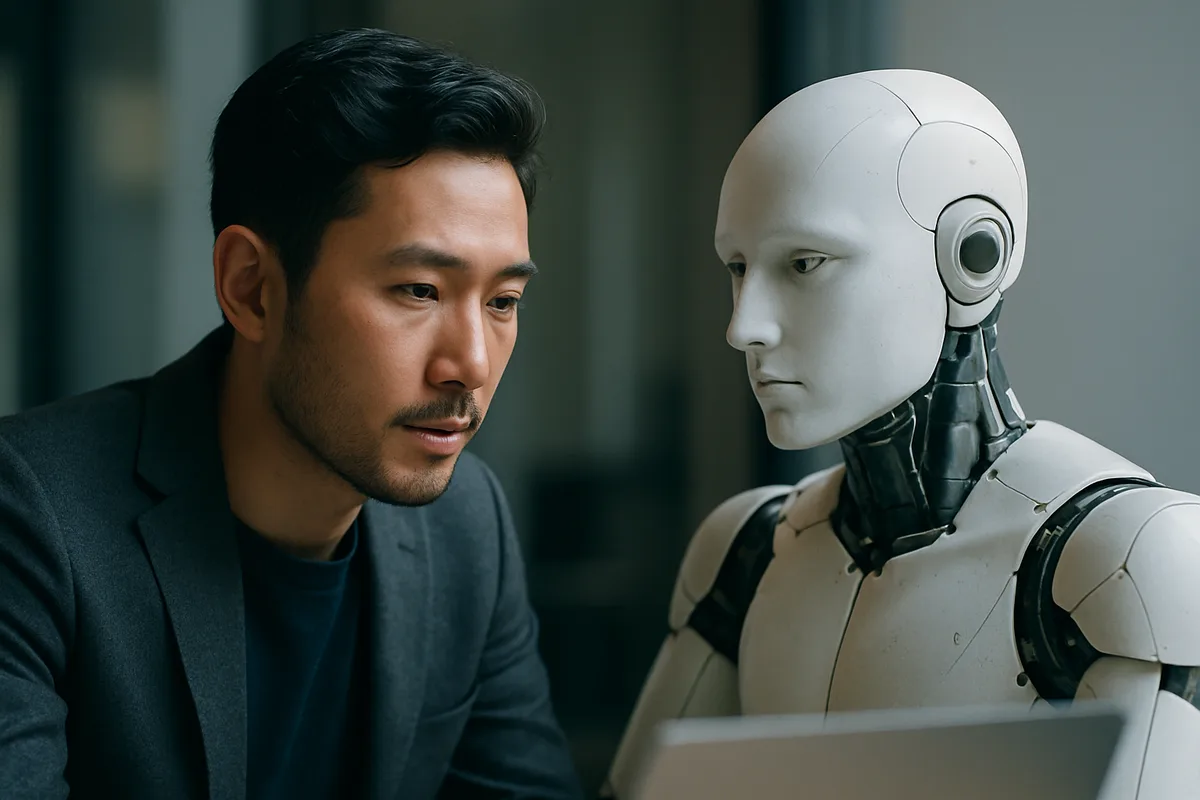
What AI Does Well and What Humans Do Better
Effective human-AI collaboration starts with a clear-eyed assessment of comparative advantage. AI excels at processing large volumes of information, identifying patterns, executing defined processes at scale, and performing consistently without fatigue. Humans excel at contextual judgment, ethical reasoning, relationship-building, creative synthesis, and navigating ambiguous situations that require values-based decisions. Collaboration designs that leverage both sets of strengths outperform those that try to force one to do the other's job.
Designing Work for Human-AI Collaboration
- Identify which tasks in each role are best suited to AI augmentation vs. human judgment
- Redesign workflows to allocate AI-suitable tasks to AI and free humans for higher-value work
- Invest in training that helps people work effectively alongside AI tools
- Create feedback loops that allow humans to identify and correct AI errors
- Monitor for automation-related skill atrophy in areas that remain important for resilience
Managing the Human Dimension of AI Transformation
The people dimension of AI transformation is as important as the technical dimension and is more frequently undermanaged. Leaders who communicate transparently about how AI will affect roles, invest in reskilling rather than simply displacing, and actively involve people in designing the new ways of working generate the organizational commitment that makes AI transformation succeed.
The Leadership Opportunity
Leaders who approach human-AI collaboration as a design challenge—rather than something that happens to their organization—create the most value. By shaping how AI and humans work together, they can simultaneously improve organizational performance, create better work experiences for their people, and build the AI capability that will become an increasingly important source of competitive advantage.
Real-World Human-AI Collaboration Examples
Across industries, organizations are moving beyond pilots to embed human-AI collaboration into core operations. In clinical settings, AI systems surface diagnostic probabilities from imaging data while physicians apply contextual judgment about patient history, risk tolerance, and treatment preferences. The AI accelerates pattern recognition; the clinician owns the decision. Neither alone produces the outcome that both together can achieve.
In financial services, credit analysts increasingly work alongside AI models that flag anomalies in loan applications and synthesize vast data streams in seconds. The analyst's role shifts from data gathering to interrogating the model's assumptions, applying market intuition, and managing client relationships — work that demands the kind of relational intelligence AI cannot replicate. This division of labor has demonstrably reduced processing time while maintaining the accountability that regulators require.
Technology and product organizations offer some of the clearest examples. Engineering teams using AI-assisted code generation tools report that developers spend less time on routine syntax and boilerplate, redirecting their attention to architecture decisions, edge-case problem solving, and cross-functional alignment. The collaboration works not because AI writes better code in all circumstances, but because it handles well-defined tasks reliably enough to free human cognition for the work that actually requires it.
Measuring Human-AI Collaboration Effectiveness
Most organizations measure AI by what the technology does in isolation — model accuracy, processing speed, or cost reduction — rather than by what the human-AI system produces together. This is a critical blind spot. A model that is highly accurate on its own can still degrade team performance if it generates overconfidence, reduces skill development, or creates bottlenecks in human review. Effective measurement starts by defining outcomes at the level of the collaborative unit, not the algorithm.
Useful metrics include decision quality over time, the rate at which humans identify and correct AI errors, workflow cycle times, and employee confidence in working with AI tools. Leaders should also track leading indicators of capability drift — situations where humans begin rubber-stamping AI outputs rather than exercising genuine judgment. When override rates drop to near zero without a clear explanation, that is often a warning sign rather than a sign of success.
Establishing a baseline before deployment and building in regular review cycles are foundational practices that many organizations skip in the enthusiasm of launching new tools. Governance structures should assign clear ownership for monitoring collaboration metrics, with the authority to adjust workflows, retrain models, or modify human touchpoints when performance signals warrant it. What gets measured in human-AI collaboration shapes the behaviors that follow.
Ethical Risks and Guardrails in AI Collaboration
When humans and AI systems work together on consequential decisions, the ethical surface area expands in ways that purely human or purely automated processes do not create. One of the most significant risks is diffused accountability — a situation where neither the human nor the AI is clearly responsible for a harmful outcome. Leaders must design collaboration models that preserve unambiguous human ownership of decisions that affect individuals, communities, or institutional reputation.
Bias is another persistent concern. AI systems trained on historical data can encode and amplify the inequities present in that data, and human collaborators who trust the tool implicitly may not scrutinize outputs with the skepticism necessary to catch systematic errors. Organizations should build structured review checkpoints specifically for high-stakes decisions, ensuring that diverse perspectives are part of the evaluation process and that dissent from AI recommendations is explicitly invited rather than implicitly discouraged.
Guardrails should be practical as well as principled. This means establishing clear boundaries on the types of decisions AI may inform versus those it may not make autonomously, creating accessible channels for employees to raise concerns about AI behavior without fear of reprisal, and conducting periodic audits that examine real-world outcomes rather than relying solely on pre-deployment testing. Ethical guardrails that exist only in policy documents but are not embedded in workflow design provide very little actual protection.
Building a Human-AI Collaboration Roadmap
A collaboration roadmap is distinct from an AI implementation plan. Where an implementation plan focuses on deploying technology, a collaboration roadmap focuses on how human roles, workflows, skills, and culture must evolve alongside it. Building one requires starting with a current-state assessment that maps which decisions are being made, by whom, with what information, and where the greatest friction or quality gaps exist. These pain points are the most credible starting places for collaboration design.
Sequencing matters considerably. Organizations that try to transform all workflows simultaneously typically generate change fatigue and produce shallow adoption. A more effective approach identifies two or three high-value collaboration opportunities, designs and tests them with the people who will actually use them, and extracts learning before scaling. This iterative approach also builds internal capability — teams that have navigated one cycle of collaboration design are measurably better at the next one.
The roadmap should include explicit milestones for the human dimension of the transformation: reskilling progress, manager capability in leading AI-augmented teams, and cultural indicators like psychological safety around raising AI-related concerns. Technology deployments have a natural forcing function in go-live dates; the human readiness work tends to slip without equivalent discipline and executive visibility. Building both tracks into a single governance rhythm is one of the clearest differentiators between organizations that capture durable value and those that accumulate shelfware.
Trust and Accountability in AI-Augmented Teams
Trust in AI-augmented teams operates on two distinct levels that leaders often conflate. The first is trust in the AI system itself — whether team members believe the tool's outputs are reliable enough to act on. The second is trust among the humans collaborating alongside AI — whether people feel safe to question model outputs, flag concerns, or advocate for a different course of action. Both levels require active cultivation, and neglecting either undermines overall team performance.
Accountability structures must be redesigned, not simply reasserted. In many organizations, accountability language carries over from pre-AI processes without anyone examining whether it still maps to how decisions are actually being made. When an AI system meaningfully shapes an outcome, the question of who is responsible for that outcome needs an explicit answer — one documented in governance frameworks and reinforced in how leaders respond when things go wrong. Defaulting to blaming the algorithm erodes the institutional credibility that effective human-AI collaboration depends on.
Leaders themselves set the accountability norm through their own behavior. When senior leaders visibly question AI-generated recommendations, acknowledge cases where human judgment added value the model missed, and hold teams to standards of genuine deliberation rather than efficient throughput, they signal that critical engagement is expected rather than optional. This behavioral modeling is often more powerful than any policy, and it establishes the organizational culture in which responsible human-AI collaboration can genuinely take hold.